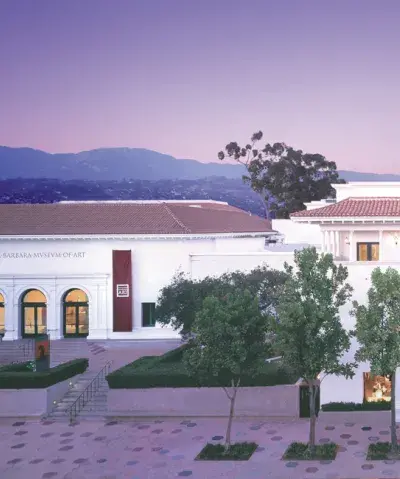
Santa Barbara Museum of Art  
 
home > exhibitions:
     

Current Exhibitions


Danny Lyon, Crossing the Ohio, Louisville, 1966. The Menil Collection, Houston, gift of Kenneth G. Futter. © 2012 Danny Lyon/Magnum Photos. Courtesy the Edwynn Houk Gallery and Dektol.wordpress.com.
  This World Is Not My Home: Danny Lyon Photographs

February 16 – June 2, 2013

This exhibition of more than 50 photographs and photographic montages, drawn from the artist’s studio and the Menil collection and spanning the period 1962 to the present, traces the fascinating and wide-ranging evolution of the career of New York- and New Mexico-based Danny Lyon. A leading and explosively creative figure in the American street photography movement of the 1960s, Lyon distinguished himself from peers like Robert Frank, Garry Winogrand, and Lee Friedlander through his direct engagement with his subjects and his concern for those on the margins of society. His goal at the outset of his career, he says, was “to destroy Life magazine” by presenting powerful, real alternatives to the hollow pictures and stories permeating American mass media in that era of conformity. In the process he created thousands of images of striking psychological, political, and aesthetic power.

Click here for full exhibition information and related programming.

The exhibition is organized by the Menil Collection, Houston. At the Menil Collection, this exhibition was realized through the generous support of Michael Zilkha, David and Anne Kirkland, Mark Wawro and Melanie Gray, H-E-B, the Robert Mapplethorpe Foundation, and the City of Houston.

In Santa Barbara, this exhibition is made possible through the generosity of Dana & Albert R. Broccoli Charitable Foundation, Susan Grimes Sweetland, and SBMA PhotoFutures.


Joaquín Torres-García, Composition, 1932. Oil on canvas. SBMA, Museum purchase with funds provided by the 20th-Century Art Acquisition and Endowment Funds, the Grace Jones Richardson Trust, Jon B. and Lillian Lovelace, and Les and Zora Charles.
  Myth and Materiality: Latin American Art from the Permanent Collection, 1930-1990

February 16 – May 26, 2013

Showcasing the Museum’s significant collection of 20th-century Latin American art, this exhibition examines the multifaceted art produced in Latin America during this dynamic 60-year period. The presentation features a diverse selection of more than 60 paintings, sculptures, works on paper, and photography from the permanent collection and selected private collections. Myth and materiality are concepts prevalent throughout the exhibition, providing platforms to consider works on both individual and universal levels—from the cosmic realm to the everyday world. Myths have long served as powerful forces in Latin American art, giving visual form to political and religious ideologies and deeply personal narratives. Materiality refers to that which constitutes the material of something or material existence, addressing the physical composition of the works considered as well as the past and present realities in which they exist.

Works combining elements of myth and materiality include Composition (1932) by pioneering abstract artist Joaquín Torres-García (Uruguayan, 1879-1949), known for his theory of Constructive Universalism, which is based on the idea that everyday symbols could be understood by all. His paintings feature a grid-like composition filled with pictographs drawn from ancient and modern cultures. Moreover, works presented in the exhibition are united by the experimental and innovative use of materials as seen in David Alfaro Siqueiros’s application of pyroxilin automotive lacquer, Alfredo Ramos Martinez’s paintings on newsprint, Carlos Cruz-Diez’s optical paintings striped with plastic slats, and Mathias Goeritz’s golden nails.

Click here for full exhibition information and related programming.

This exhibition is made possible through the generosity of Dody Waugh, Anne and Houston Harte, and Jacquelyn Klein-Brown.


Edgar Degas, Three Dancers in Yellow Skirts, ca. 1891. Oil on canvas. Michael Armand Hammer and the Armand Hammer Foundation.
  Degas to Chagall: Important Loans from The Armand Hammer Foundation and the Collection of Michael Armand Hammer

Ongoing

The Santa Barbara Museum of Art is delighted to present a selection of important paintings that are on extended loan by The Armand Hammer Foundation and augmented by several works from the private collection of Michael Armand Hammer. The mandate of the Foundation is to share an extraordinary collection of works bequeathed by its founder with the public by lending to museums throughout the country.

The paintings on view from The Armand Hammer Foundation represent just a small fraction of the ravishing collection put together by Dr. Armand Hammer (1898-1990), perhaps best known for the extraordinary works of art he donated to his namesake institution, the Hammer Museum at the University of California, Los Angeles, from 1965 through 1990. These works complement seamlessly our Museum's rich holdings in the areas of French Impressionism and Post-Impressionism, installed in the contiguous Ridley-Tree Gallery. Artists represented include Ivan Aivazovsky, Pierre Bonnard, William-Adolphe Bouguereau, Jean-Baptiste-Camille Corot, Marc Chagall, Edgar Degas, Daniel Ridgway Knight, Henri Fantin-Latour, Berthe Morisot, Camille Pissarro, and Auguste Renoir.

Click here for full exhibition information and related programming.


Colin Campbell Cooper, California State Building, San Diego Exposition, 1916. Oil on canvas. SBMA, Gift of the Family of the Artist.
  California Dreaming: Plein-Air Painting from San Francisco to San Diego

December 15, 2012 – June 23, 2013

This exhibition presents a selection of early modern paintings that celebrate the topography of California. By the end of the 19th century, landscape painting had become the primary vehicle for depicting national identity in American art. California provided breathtaking scenery of newly integrated lands for painters working “en plein air,” or outdoors. This was an approach employed by cutting-edge artists in Europe, particularly in France, which artists in America then adapted to create a style that has become the hallmark of what is commonly termed Californian Plein-Air Painting or California Impressionism. In Northern California, an atmospheric, poetic and decorative style called Tonalism was established by the artistic community of San Francisco. Southern California was a mecca for young, modernist artists influenced by French Impressionism, a movement preoccupied with capturing the immediate effects of light and color under ever-changing climactic conditions. The regional style of California Plein-Air Painting was created by a group of cosmopolitan painters, whose mobility was facilitated by the new railroad lines to the West Coast. While technically varied, all of the artists represented here were utterly devoted to depicting the natural paradise we aptly call the Golden State.


Childe Hassam, The Manhattan Club, n.d. (ca. 1891). Oil on canvas. SBMA, Gift of Mrs. Sterling Morton to the Preston Morton Collection.
  Scenery, Story, Spirit: American Painting and Sculpture from the Santa Barbara Museum of Art

On View Through May 26, 2013

Between the 1830s and the end of the First World War, American art came into its own. From the majestic Hudson River School paintings of Thomas Cole, John Kensett, and Albert Bierstadt to the gritty urban realism of Robert Henri and John Sloan, this presentation draws on the rich holdings of American paintings and sculptures in the collection of the Santa Barbara Museum of Art. Organized by guest curator Peter John Brownlee, this selection highlights the maturation of a distinctly American idiom, one informed by international currents and engaged with capturing the fluxes of modern life. Masterpieces of landscape, genre, still-life, and portraiture, punctuated by a selection of sculptures, trace an evolution in style from an art driven by the mandates of westward expansion to one animated by experimentation. In both idealized and naturalistically rendered landscapes, in scenes of everyday life, or meticulously detailed images of everyday objects, the presentation also narrates an important chapter in American cultural history that witnessed the Civil War and its aftermath, the expansion of national boundaries and the closing of the western frontier, and the transformations wrought by the emergence of new technologies at the dawn of the 20th century.


Martin Kersels, Charms (Black Cloud/Green Dog/Little, Little Boy/Red Chair/White House/Silver Clouds), 2012. SBMA, Museum purchase with funds provided by The Museum Contemporaries, 2012.44a-k.
  Martin Kersels' "Charm" Series

Ongoing

The installation of nine newly commissioned sculptures from the "Charm" series by renowned artist Martin Kersels debuted in the Park Entrance atrium of the Museum on November 10, 2012 and will remain on view for an extended period.

Kersels' "Charms" are works that incorporate found objects and shapes to form iconic sculptures, some of which are illuminated, that hang from the ceiling. Nine sculptures from the series comprise the installation: Little, Little Boy; Green Dog; Black Cloud; White House; and five Silver Clouds. Suspended from a large ring—like charms on a bracelet—the works cast light and shadow on the interior walls, creating "a constellation of brightness and shadow."

This exhibition is made possibe through the support of The Museum Contemporaries, Santa Barbara Museum of Art. Additional support is provided by the Santa Barbara Museum of Art Women's Board.


Copyright © 2013 Santa Barbara Museum of Art. No images or information may be reproduced,transmitted or copied without permission.