 |
 |
Reframing America
Reframing America is the unifying theme for five exhibitions that address, each in an
idiosyncratic way, the concept of America. All five presentations imagine America
differently, while also examining it as not just a place, but also as an idea—
one with a past, present, and future.
Stranger Than Fiction: Narrative in Works by Selected Contemporary Artists
September 18, 2010 – January 2, 2011
Chasing Moby-Dick: Selected Works by Tony de los Reyes
September 18, 2010 – January 2, 2011
Yosemite: Then and Now
October 2, 2010 – January 23, 2011
An American Century: 20th-Century Master Drawings from the Collection
October 9, 2010 – January 2, 2011
American Modernism: Selections from the Permanent Collection
October 9, 2010 - January 2, 2011
|
For more information about the Stranger Than Fiction and Chasing Moby-Dick exhibitions, including highlighted works, artist profiles, and related programming, go to our blog at http://blog.sbma.net/
1st Thursdays and Family 1st Thursdays
Thursdays, December 2; January 6, 5 - 8 pm
Atelier: Chasing Moby-Dick
Friday, December 3, 5 - 7 pm
Artist Gallery Talk: Plotlines
Sunday, December 5, 2:30 pm
Studio Sundays on the Front Steps
Sunday, December 12, 1:30–4:30 pm

Noah Davis, inBoil and Margaret, 2010. Oil on canvas. Courtesy of Roberts & Tilton, Culver City, CA.
Stranger Than Fiction: Narrative in Works by Selected Contemporary Artists
September 18, 2010 - January 2, 2011
Campbell/Gould Galleries
The first two exhibitions on view in this series take their cues from the realities of the past and present, as well as the fantasies that these realities may inspire. Stranger Than Fiction features works by 11 mostly young, mostly Southern California artists whose inspiration rises from both fact and fiction, and the surprising results of the conflation of the two. References to literature, history, allegory, and fantasy converge in these works, posing new fictions and realities, and challenging the fine line between both. Archetypal American subjects dominate these works, which range in reference from colonial history, to religious iconography, to 1970s literature and comics, and to contemporary film and pop music.
An example includes Noah Davis’ work inBoil and Margaret, part of a series of work inspired by the 1968 novella In Watermelon Sugar, written by Richard Brautigan. The title refers to two of the books protagonists who live in a fantastical commune set against an ever-changing landscape where most things are made of watermelon sugar. This degree of whimsy-meets-reality sets the stage for the remainder of the artists in the exhibition in their inventive, wry, poignant and thought provoking works.
Artists represented in the exhibition are Eric Beltz, Dawn Clements, Erin Cosgrove, Noah Davis, Kerry James Marshall, Aaron Morse, Allison Schulnik, Jeni Spota, Devin Troy Strother, Frohawk Two Feathers, and Nicolau Vergueiro.

Tony de los Reyes, The Needle, 2010. Ink and Oil on linen. Collection Mike Healy and Tim Walsh.
Chasing Moby-Dick: Selected Works by Tony de los Reyes
September 18, 2010 - January 2, 2011
Sterling Morton East/West Galleries
Tony de los Reyes carries the theme of merging iconic subject matter and historic aesthetic styles further in this exhibition of paintings, drawings, and sculpture. For the past five years, his attention has been fixated on what is referred to as the Great American Novel—Herman Melville's Moby-Dick (1851). The style of these works, which are the focus of this exhibition, references Abstract Expressionism and Minimalism, movements associated with rugged individualism and "pure" materiality. The depiction of various nautical imagery with various materials, including dark inks and bronze, alludes to the complex multiple perspectives in the narrative. Yet the most powerful effect of this work is its examination of Melville's epic as a mythic vision of America. The artist's distinctive comparisons of Ahab and the U.S. enhance the insatiable and potentially self-destructive nature of both.
Peter Frank reinforced this notion in a review in LA Weekly (April 9, 2008) on a showing by the artist at Carl Berg Gallery, "Tony de los Reyes’ own musings have led him to Moby Dick. That intractable monument of American literature has inspired, and daunted, countless artists of all kinds and all complexities, but de los Reyes’ approach is at least on one level relatively straightforward. In slathering bloody red paint across portions of text, de los Reyes conjures the blood lust that permeates the story. The aura of violence continues in the sculptural work, commingling skulls, stars (i.e., five-pointed American-flagtype star symbols) and other tropes that point to America’s heart of darkness — sheathed, as de los Reyes intimates, in a skin of whiteness.”

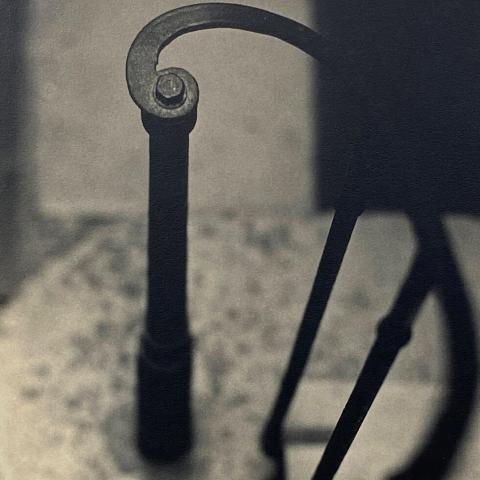
Ansel Adams, Cloud and Mountain, 1927. Parmelian print. Santa Barbara Museum of Art, Museum purchase with funds provided by the Wallis Foundation.
Yosemite: Then and Now
October 2, 2010 - January 23, 2011
Von Romberg and Emmons Galleries
The bridge from the past to the 21st century is created in views of the majestic Yosemite landscape. Since the moment the first photographs of this natural wonder were seen, this unparalleled landscape became a photographer’s mecca. From the traditional views, made by Carleton Watkins and Eadweard Muybridge in the 1860s, to modern abstractions by David Stroup and Kate Jordahl, Yosemite is both sublime subject and spiritual metaphor.
In 1864 President Abraham Lincoln signed a bill preserving Yosemite, embracing nearly ¾ million acres. The photographs in this exhibition demonstrate not only the changing medium of photography but also the changing perception and meaning of this iconic national park, which has since been named a World Heritage Site.
Drawing from the growing collection of photographic images in SBMA’s permanent collection, the exhibition ranges from the 1860s to 2004 and includes mammoth-plate images by the pioneers of the 19th century, the well-known views of Ansel Adams in the 20th century, and the time-lapse images of Trevor Paglen in the 21st century.
Millard Sheets, Spring Street, Los Angeles, 1929. Watercolor. Santa Barbara Museum of Art, Museum purchase, The Dicken Fund.
An American Century: 20th-Century Master Drawings from the Collection
October 9, 2010 - January 2, 2011
McCormick Gallery
The anchor of Reframing America is An American Century, a look to the past of American art of the 20th century and SBMA’s significant collection of works on paper. Comprising more than 75 works, the exhibition represents some of the nation’s best artists across almost a full century. At every point of significant shifts in style and subject matter—from the realist works of the Ashcan artists to abstract modernists—SBMA’s collections contains major works by major artists. The exhibition represents a history of American art, surveying both the diversity of techniques and materials that artists may use when they draw, and the period when art production in the United States became internationally significant. The collection also has a strong California flavor, and is prosperous in drawings that document the ways in which California artists have explored their own preoccupations, until they arrived on the national scene in the last few decades.
The richness of the collection allows a glimpse into the dynamic social and cultural changes experienced by these artists and their audiences. Everett Shinn’s gouache of a crowd of shoppers on a Sixth Avenue sidewalk in Manhattan contrasts with Arthur Mathews’ glamorous study of an idealized modern city, intended to be placed in the Sacramento State Capitol; both were painted in the first decades of the last century. The city, depicted in both a positive and negative light, is a subject that has continued to preoccupy American artists ever since, from John Marin’s jazzy cubist take on the frenetic construction in Manhattan in the Roaring Twenties to Christo’s repackaging of the Pont Neuf in Paris in the 1980s. Also painted in the first years of the last century, Lucia Mathews’ watercolor of a Carmel Valley oak tree contrasts with Fernand Lungren’s watercolor of the Mojave Desert: nature in all its variety, and the relationship to it, is another subject that fascinates and confounds artists.
The exhibition includes a group of drawings by leading Californian and Ashcan artists, and shifts into high-gear with a stunning group by the major early modernist artists that are a particular strength of the collection, like Charles Demuth, Charles Sheeler, and Joseph Stella. Regionalist and realist works from the 1930s and 1940s are also well represented, by artists like Edward Hopper, John Steuart Curry, George Grosz, and Jacob Lawrence. But there are also surprising works by little known artists, and works that have not been exhibited in a long time, by such artists as Dorr Bothwell and Romaire Bearden. The shift to abstraction is registered with major works by Morris Graves and Mark Tobey. An eclectic group of major works by Philip Pearlstein, Christo, Nancy Graves, and Larry Rivers rounds out this story.
This exhibition has been curated by Bruce Robertson, Consulting Curator, in collaboration with Robert Henning, former Chief Curator.

Marion Post Wolcott, Jitterbugging in “Juke Joint,” Clarkdale, Mississippi, 1939. Gelatin silver print. Santa Barbara Museum of Art, Museum purchase with funds provided by Mercedes H. Eichholz.
American Modernism: Selections from the Permanent Collection
October 9, 2010 - January 2, 2011
Davidson Gallery
Complementing the drawings in An American Century, the exhibition American Modernism showcases photographs and paintings from the Museum’s extensive collection of American art. While An American Century surveys the whole century, the 37 works in American Modernism concentrates on the decades of the early 20th century, beginning in 1910. In that crucial period – the build-up to World War I and the turbulent years between the World Wars, both American artists and their audiences experienced modernity in very personal ways.
The exhibition features three sections: the modernists who explored landscape and nature as a way of retreating from industrial and urban change; the artists who explored the vernacular and colloquial forms of American culture; and an outsider artist, who strove to integrate his indigenous past with Southern Californian realities.
Highlights in the first section include Georgia O’Keeffe’s stark image of a dead tree and Anne Brigman’s poetic photographs of female nudes emerging like dryads from tree trunks. Marion Post Wolcott and Walker Evans’ explorations of the vernacular ordinary scenes and simple pleasures, exemplified in Jitterbugging in “Juke Joint,” Clarkdale, Mississippi stand in vivid contrast to Trude, Walt Kuhn’s assertive figure of a vaudeville performer. In the final section, the work of Alfredo Ramos Martinez, a Mexican artist who negotiated a career between Mexico and the United States, reflects the changing complexion of American life.
|
|